
Lower back pain? What are the different types of lower back pain? When should I consult an osteopath for my back?
Low back pain
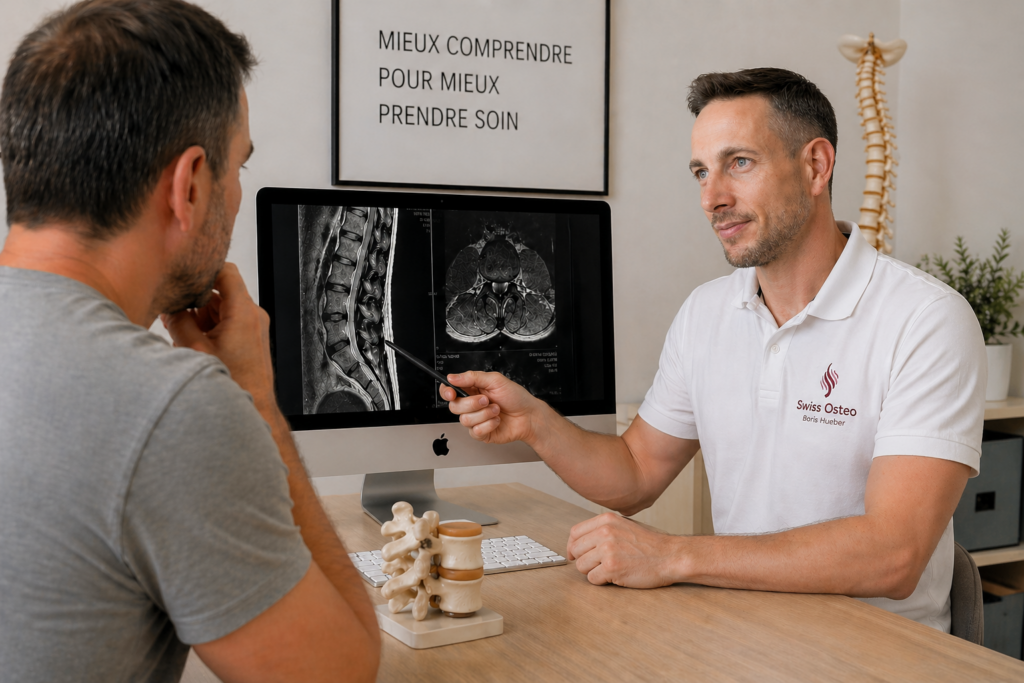
Pain in the lower back around the spinal column. There are different types of low back pain. First, the osteopath will analyze and perform clinical tests to differentiate between common low-back pain (lumbago, functional cruralgia and sciatica…), of functional mechanical origin, and organic low-back pain (neurological damage, such as sciatica in the presence of a herniated disc). In the latter case, you will be referred to a specialist such as a neurologist, or to your GP for a specific complementary examination such as an MRI.
Lumbago
Lumbago can originate in the psoas-iliac muscle.
This muscle (among others) is involved in lumbago. We bend down to pick up an object and our back is blocked. This muscle has been overused before, remaining contracted, and the act of bracing ourselves has stretched it too violently and coldly. Lumbago, often referred to as acute lumbago, is a disc strain.
This type of muscular pain is also commonly referred to as “kidney ache” or “kidney strain”, even though the kidney organ itself is not affected.
Symptom : Painful muscle contractions in the lumbar vertebrae (lower back).
Cause: A crack in the intervertebral disc, and the nucleus moves into the crack.
However, the nucleus has not come out of the annulus: this is not a herniated disc (there is no pinched nerve), but a sprained disc accompanied by muscle contracture.
Unlike sciatica, lumbago is not characterized by pain in the buttock or leg.
Cruralgia
Cruralgia: Irritation of the L3 and L4 nerve root.
Cause : A cracked intervertebral disc and compression of the crural or femoral nerve.
Symptom: Pain in the back and/or thigh and/or calf:
Cruralgia L3: lower back, front of thigh, front of knee.
Cruralgia L4: lower back, front of thigh, inside calf.
Sciatica
Sciatica can be caused by the piriformis or pyramidal muscle.
This muscle can cause sciatica-like pain. The sciatic nerve runs through the pyramidal muscle. This means that excessive and sustained contraction of this muscle can lead to sciatica-like pain, but this is not sciatic nerve damage.
Sciatica: Irritation of the L5 and S1 nerve roots.
Cause: a cracked intervertebral disc and compression of a sciatic nerve.
Symptom : Pain in back and/or buttock and/or thigh and/or calf and/or foot and/or toe: – sciatica L5: lower back, buttock, outer thigh, outer calf, top of foot, big toe.
Sciatica S1: lower back, buttock, back of thigh, back of calf, bottom of foot, little toe.
Unlike lumbago, sciatica is characterized by pain in the buttock or down the leg.
Maigne syndrome
Maigne syndrome is also known as dorsolumbar hinge syndrome. It refers to a range of pains caused by nerve irritation in the dorsolumbar region (the transition zone between the upper and lower back).
More specifically, Maigne syndrome is the result of irritation of the nerves emerging from vertebrae D12 (12th thoracic vertebra) and L1 (1st lumbar vertebra).
Causes: Maigne syndrome is the result of nerve irritation in the dorsal-lumbar zone, i.e. the junction between the dorsal part of the spine and the lumbar part. This area is particularly stressed, as the dorsal spine is highly mobile, unlike the lumbar spine, which has little rotation.
Irritation of the nerves in the dorsolumbar region can occur in particular in the case of :
Minor intervertebral derangement in the posterior part of the joint.
Posterior articular osteoarthritis.
Disc pathology affecting the intervertebral discs.
Symptoms : Maigne syndrome is characterized by a series of projected pains in the lower back. These pains are referred to as “projected” because they occur not at the level of nerve irritation, but at the level of the regions innervated by these nerves. In the majority of cases, the areas affected are the lower lumbar region, the upper part of the buttocks, the sacrum, the groin fold, the labia majora or scrotum, the trochanteric region (hip) and the lateral aspect of the thigh.
Risk factors for low back pain
Bad postures
Stretch backwards: belly bulges (disc nucleus moves forward).
Lean forward: round back (disc nucleus moves backwards).
Bending over to tie shoelaces: avoid bending your trunk.
Sit with your back arched forward.
Turn on your side: avoid twisting (rotation) your back.
Turn on your side, leaning forward (shoulders shifted to the sidé in relation to the hips.)
The right postures
Bend your knees as you squat, keeping your back straight.
Keep your back straight but not too straight: respect the natural curves of your back.
Prefer to wear a backpack (straps on both shoulders).